
Linux Installation#
The following instructions were designed for Ubuntu/Debian, but should be easily adaptable to other Linux distributions.
Installer Script#
We now have an automated Linux installer, available on our github page. To use:
./chipwhisperer_installer.sh -up /path/to/install
There are two steps that require elevated permissions. The first, done if you use the -p flag, is to automatically install
required prerequisites. Note that this only works on Ubuntu. On other platforms, you’ll need to manually install these. See the manual
install section. The second, the -u flag is to setup USB permissions. If you want to do this step manually, see the manual install section.Labs
After running the installer, reboot your computer, and the install should be completed. This script gives you two helper scripts in the
install directory. Running runcw.sh will setup your environment and run Jupyter, which will open a tab in your browser:
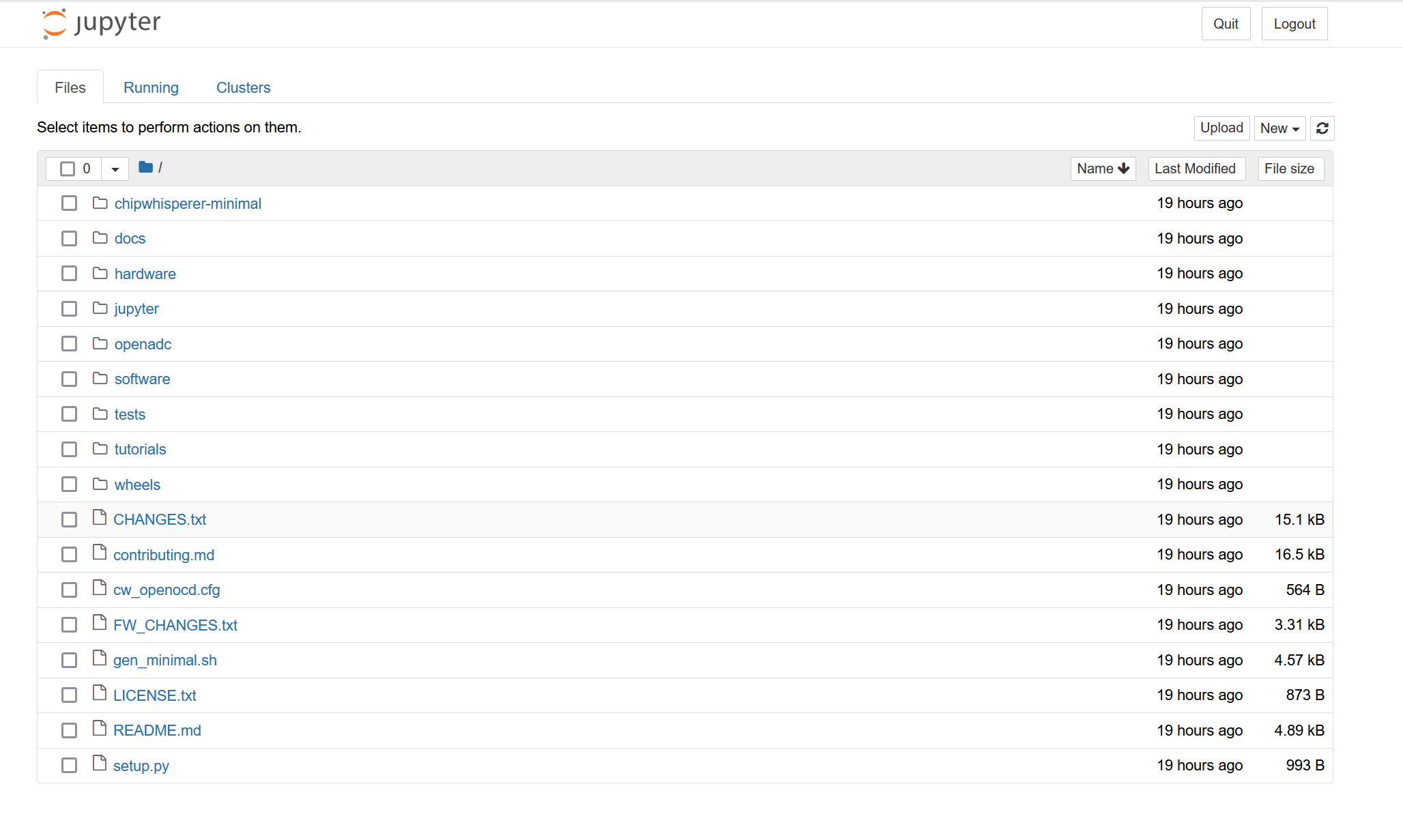
There’s also setup_cw_env.sh, which sets up your environment, but does not run Jupyter.
Setting USB permissions can sometimes go wrong, so you may want to start Jupyter, open Jupyter/Test Connection.ipynb, and run the code blocks to make
sure you can connect to your ChipWhisperer.
Manual Installation#
Note
To avoid conflicts with other packages and to avoid messing up your python environment, we recommend using a virtual environment for ChipWhisperer. Don’t forget to activate the virtual environment before trying to run python or jupyter!
Required Packages#
Begin by updating all your packages:
sudo apt update && sudo apt upgrade
Next, grab the prerequisites for building firmware for targets, as well as python:
sudo apt install libusb-dev make git \
    gcc-arm-none-eabi libusb-1.0-0-dev usbutils
Note
The installer script downloads a specific version of the arm gcc compiler to minimize the effects of changing compilers on labs. You may want to get version 13.2 of arm-none-eabi-gcc to mimic the installer script.
Python#
The recommended way to use Python with ChipWhisperer is to install everything in a virtual environment. Luckily, Python makes this easy!
The first step is to grab the python, python-dev, and python-venv packages:
sudo apt install python3 python3-venv python3-dev
Next, we need to create a virtual environment:
python3 -m venv ~/.cwvenv # place this anywhere you like, but don't forget to update path in the next step
You can then activate your virtual environment to get access to Python:
source ~/.cwvenv/bin/activate # or wherever you installed your venv
Installing ChipWhisperer#
Start by grabbing ChipWhisperer from Github. Install wherever you like, but the code below will download it to your home directory:
cd ~/
git clone https://github.com/newaetech/chipwhisperer
cd chipwhisperer
git submodule update --init jupyter # grab Jupyter notebook tutorials
Next, we’ll need to make some udev rules so that we have permission to access USB and serial devices. ChipWhisperer includes a default set of rules that give you access to NewAE USB devices:
sudo cp 50-newae.rules /etc/udev/rules.d/50-newae.rules
sudo udevadm control --reload-rules
Those rules actually give permission to the chipwhisperer group, so you’ll need to create that group and add your user to that group:
sudo groupadd -fr chipwhisperer # new systemd versions require system accounts for udev
sudo usermod -aG chipwhisperer $USER
sudo usermod -aG plugdev $USER # may not be available on your system
With that done, all that’s left is to install ChipWhisperer:
python -m pip install -e .
python -m pip install -r jupyter/requirements.txt
You’ll need to reboot now to get access to the ChipWhisperer USB devices.
You can check that the install succeeded by navigating to chipwhisperer
and running:
source ~/.cwvenv/bin/activate
jupyter notebook
Which should open a window like the following in your browser: